

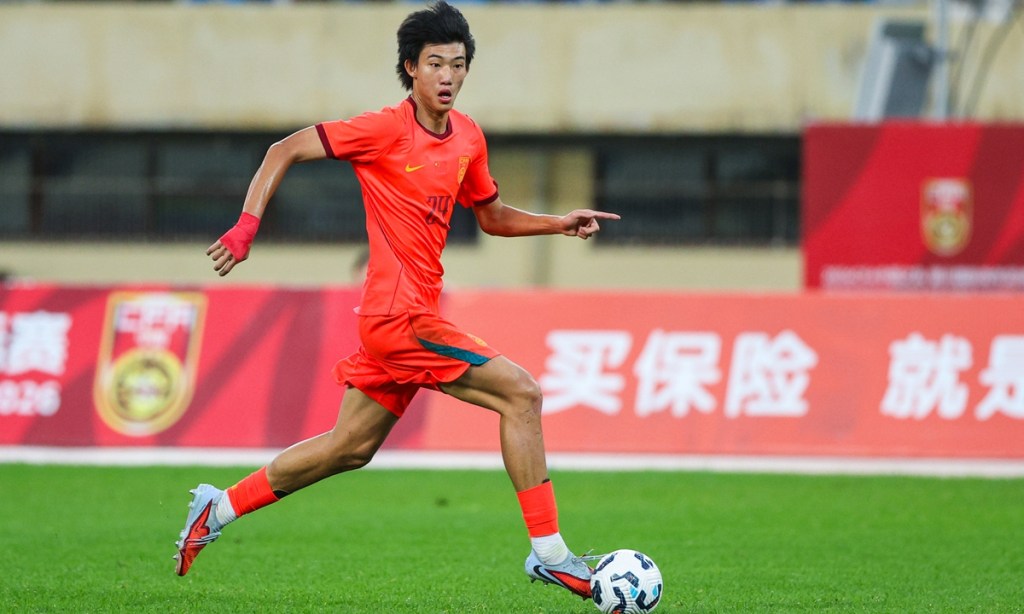
Position: Centre Forward
Height: 1.94 m
Preferred Foot: Right
Age: 17 (Born in 2009)
Nationality: Chinese
Club: Tsinghua University High School
National Team: China U17 / National Team
Category: B2
Development Category: F2
Updated | October 2026
Executive Summary
A 1.94 m centre forward with a natural goalscoring instinct, strong aerial ability and a good understanding of positioning inside the box. Throughout 2026, he has expanded his game on the ball, showing progress in ball carrying and overall attacking involvement. His main limitation remains his ability to retain possession and link play when receiving under pressure. His international experience this year supports a positive assessment of his development, although he has yet to prove that these qualities can translate consistently to professional football. Rating: B2/F2. Recommendation: priority scouting follow-up during the FIFA U-17 World Cup, with particular attention to his performances against physically and tactically demanding defenders.
Technical Assessment
Finishing is his strongest attribute. He attacks crosses with conviction, times his jumps well and knows how to gain an advantageous position before attempting a finish. He makes effective use of his reach and can finish with his feet using minimal touches, particularly when receiving in favourable positions inside the penalty area.
He has improved his ball carrying and individual attacking actions, as demonstrated during the Shanghai Future Star Cup. When receiving facing goal with space ahead of him, he can drive forward and attack the opposition’s defensive line. However, his first touch remains inconsistent under pressure, and he struggles to direct the ball effectively when receiving with his back to goal and a centre-back tight to him. His lay-offs and one- or two-touch combinations need greater accuracy if he is to contribute more reliably to build-up play.
Tactical Assessment
He is a number nine who prefers to operate on the opposition’s last defensive line. He can pin centre-backs, attack the space between them and exploit moments when defenders lose sight of the ball. Inside the box, he reads situations well, knowing when to attack the near post and when to hold his position for a second delivery. His presence is particularly valuable when his team progresses through wide areas.
Outside the penalty area, he has added more supporting movements and can draw defenders away to create space for teammates. However, he still alternates well-timed runs with movements made too early, taking himself away from scoring positions without providing a clear passing option. Out of possession, he shows a willingness to press centre-backs and block passing lanes, but his coordination with teammates and consistency of effort require improvement. At present, he is better suited to a side that makes use of his presence in the final third than one that relies on its striker to organise attacks between the lines.
Physical Assessment
His height gives him reach and a strong presence in aerial duels. He is reasonably coordinated for his size and can attack space when given room to run. His initial acceleration and ability to change direction quickly are not standout attributes.
He still needs to develop greater strength and body stability. Against senior centre-backs, he will have to protect the ball more effectively, withstand physical contact and learn to use his body without compromising his mobility. This will be an important factor in determining how much of his current physical advantage he can maintain at higher levels.
Mental Assessment
He shows confidence in front of goal and is willing to take responsibility for finishing attacks. During the Shanghai Future Star Cup, he responded well against international academy opposition and showed initiative in attacking situations rather than simply waiting for service.
His appearances with the senior national team against Maldives, Palestine and Tajikistan have exposed him to a more demanding environment. The next stage of his assessment should focus on how he responds when his team struggles to create chances, when he loses successive duels or when he must contribute to the collective effort with limited involvement on the ball. A larger sample of matches is still needed to assess his mental consistency in these situations.
Projection
His development throughout 2026 has been positive, particularly in his ball handling and the variety of his attacking movements. His performances against academies such as Arsenal, Bayer Leverkusen, River Plate and Athletic Club provide encouraging evidence, although these observations remain within the context of youth football.
The FIFA U-17 World Cup will offer an opportunity to assess how he handles defenders with different physical and tactical profiles. Of particular interest will be his ability to play against quick centre-backs, withstand contact and remain an attacking threat when China are unable to control possession.
In the medium term, he needs to move into a competitive environment where he can face senior opposition regularly. The priority should be consistent playing time and continued technical development, rather than accelerating his progression solely because of his international exposure.
Risk Factors
The main question concerns his adaptation to a level of football where players have less time and space to execute their actions. Unless he improves the quality of his receiving and combination play, he could become dependent on teams that consistently create finishing opportunities for him.
He must also demonstrate that he can compete physically against stronger, more experienced centre-backs. His lack of sustained professional playing experience makes it difficult to establish his competitive ceiling with confidence.
Final Assessment
Zhao Songyuan has qualities that warrant serious scouting attention. His greatest strength is not simply his height, but his ability to recognise where he needs to be to finish attacking moves. He has a natural eye for goal, good movement inside the penalty area and an attacking skill set that has developed positively over the course of the year.
He remains a developing striker. His performances outside the penalty area need greater consistency, and he must learn to compete against defenders who do not allow him a physical advantage. His senior international appearances are valuable experience, but they are no substitute for regular involvement in professional competition.
I maintain his B2 Category and F2 Development Category. His progress deserves close attention, although there is not yet sufficient evidence to justify a higher rating.
For European clubs, I recommend monitoring him during the FIFA U-17 World Cup, particularly when the match does not suit his strengths. Beyond his goalscoring output, it will be important to assess whether he can hold his own in duels, combine effectively with teammates and maintain his attacking influence against organised defensive units. His finishing instinct is already evident; his ability to develop into a more complete centre forward will determine how far he can progress.


Deja una respuesta